Articles
Sep 18, 2026
Can You Have Dental Implants if You Have Gum Disease?
Gum disease doesn’t always rule out dental implants. Learn what needs treating first and when full mouth implants may still be possible.

Gum disease doesn’t always rule out dental implants. Learn what needs treating first and when full mouth implants may still be possible.

Dental implants are still possible — even after gum disease
A history of gum disease does not automatically prevent you from having dental implants. What matters most is that the infection is stabilised and the mouth is healthy at the time of implant placement. With detailed planning, guided surgery, and the right implant approach, fixed teeth can often be achieved even in cases involving significant bone loss.
At Implantly, we specialise in treating patients who have been told they are “not suitable” elsewhere. Our clinical teams focus on long-term stability, infection control, and predictable outcomes.
The only way to know whether implants are right for you is through a proper clinical assessment. We provide clear, honest advice based on 3D scans, bone quality, and your long-term oral health.
In this guide, we’ll explain:
Gum disease (also known as periodontal disease) is an infection of the gums and the bone that holds your teeth in place. It usually develops gradually and progresses through two main stages:
Gingivitis (Early gum disease)
This is the early stage of gum disease. Gums may look red or swollen and may bleed when brushing. At this point, there is no permanent damage, and the condition can usually be reversed with professional cleaning and good oral hygiene.
Periodontitis (Advanced gum disease)
If gingivitis is left untreated, it can develop into periodontitis. Bacteria begin to destroy the bone and tissues supporting the teeth, causing gums to recede and teeth to loosen. Over time, this can lead to tooth loss.
Unlike tooth decay, gum disease attacks the foundations of your teeth. As bone is lost, teeth become unstable and eventually fail. Many patients who come to Implantly have lived with this condition for years, often managing symptoms rather than addressing the underlying cause.
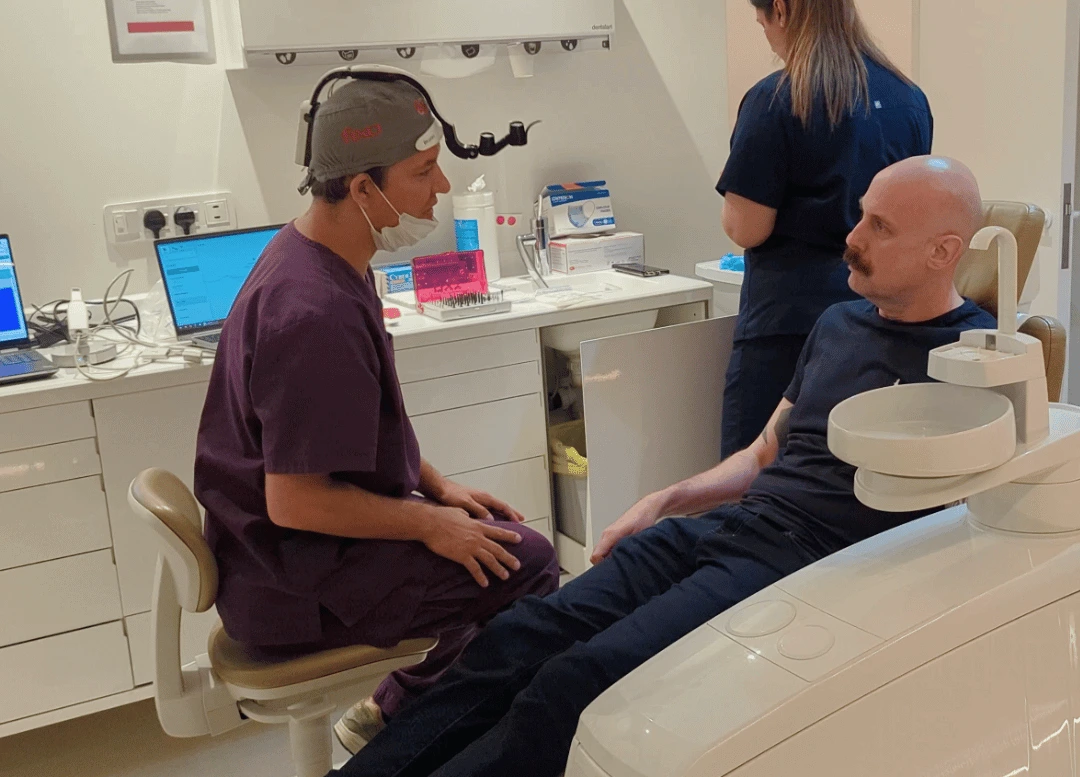
Dental implants are placed into the jawbone, not just the gum tissue. For implants to succeed long-term, both the bone and the surrounding gums must be healthy.
If gum disease is still active when implants are placed:
This is why untreated gum disease must always be addressed before implant treatment. However, this does not mean implants are no longer an option – it simply means the right preparation is essential.
The first priority is stopping the gum infection. This may involve:
Once the disease is under control, we carry out detailed 3D scans to assess how much bone remains and where implants can be safely placed. Every mouth is different:
When gum disease has already compromised the teeth beyond repair, removing them and replacing them with a fixed implant solution can:
The good news is that once gum disease is under control, implants can still be a long-term, cost-effective solution.
Yes – once gum disease is controlled, dental implants can be a highly effective solution. They can:
The most important factor is timing. Gum disease must be treated first, and the mouth must be healthy at the time of implant placement.
Some patients are told they’re not suitable for implants because gum disease has caused significant bone loss. At Implantly, we regularly help patients who’ve been turned away elsewhere.
Our experienced clinical teams use advanced planning and implant placement techniques that allow us to work with limited bone. This often means:
Even if gum disease has left you with very little natural bone, there may still be a permanent dental implant solution available.
Why gum disease should never be ignored
Placing implants without treating gum disease first can lead to:
Treating the disease first is essential for long-term success and is a core part of our approach at Implantly.
When it comes to dental implants, experience and precision matter. At Implantly, we combine affordability with clinical excellence:
How much does whole mouth dental implants cost?
At Implantly we are proud to offer UK’s Most Affordable Cost at £14,995. No hidden costs.
Can I have implants if I currently have gum disease?
Active gum disease must be treated first. Once controlled, many patients can go on to have implants.
I’ve already lost teeth due to gum disease – can implants help?
Yes. Fixed full mouth dental implant solutions are often ideal in these situations.
What if I’ve been told I don’t have enough bone?
Implantly specialises in complex cases and advanced implant techniques that may avoid the need for bone grafting.
How long does full mouth surgery take?
Around 2–3 hours per jaw.
Will it be painful?
Most patients experience mild discomfort and swelling for 7–10 days. Over-the-counter pain relief is typically sufficient for recovery.
Do implants last forever?
With good oral hygiene and regular check-ups, implants are designed to last for decades.
A history of gum disease doesn’t automatically rule out dental implants. With proper treatment and the right clinical expertise, implants can restore your smile, comfort, and long-term oral health.
At Implantly, we’ve helped many patients who believed they had no options left. Our team is here to assess your situation honestly and guide you towards the best solution for your needs.
If you’re concerned about gum disease and wondering whether dental implants are right for you, book a free consultation with Implantly today. Your assessment includes a full examination, 3D scans, and clear advice about your options.